














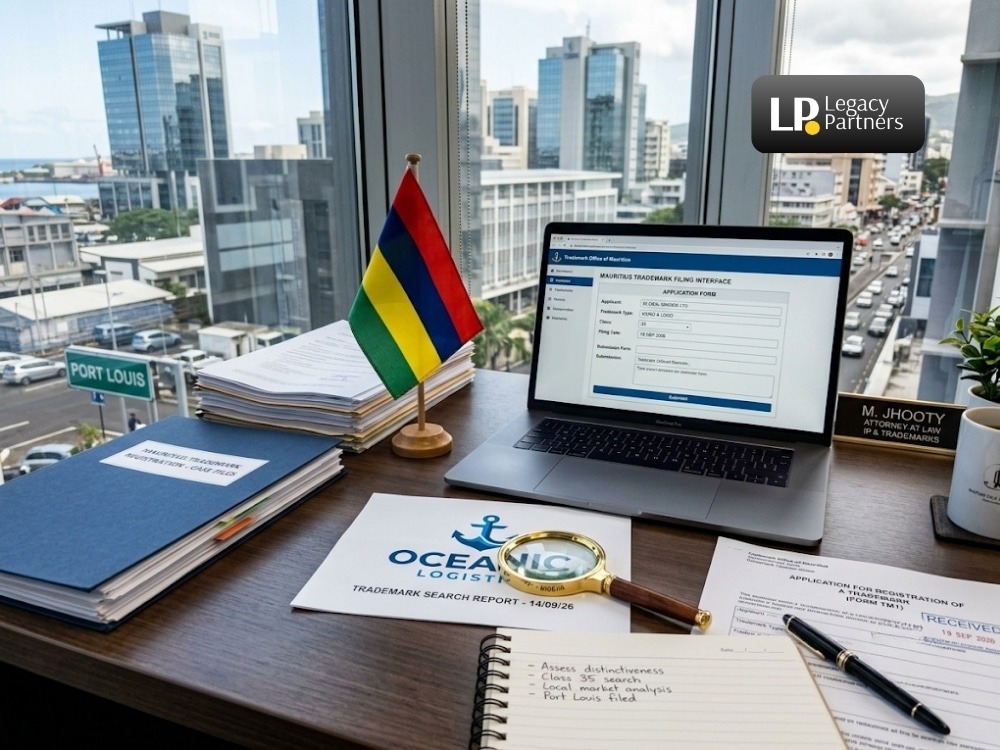


Trademark Registration in Mauritius: How to File, Protect and Renew Your Brand
Mauritius principally operates on a registration and filing-priority basis. Earlier registration, filing or priority dates are important when determining conflicting trademark rights. However, prior use can also be relevant, as the law permits a prior user to oppose a later application in certain circumstances where evidence of prior use is submitted For businesses using Mauritius as an African and Indian Ocean gateway, that single rule decides how quickly you should move.
Which Law Governs Trademarks in Mauritius Today?
The Industrial Property Act 2019 is the operative law. It replaced the earlier 2002 framework, created a consolidated Industrial Property Office of Mauritius, and modernised the regime by allowing multi class applications and by preparing the ground for international filings.
Mauritius is a member of WIPO, the Paris Convention and the WTO TRIPS Agreement. Paris Convention membership means you can claim priority from a first filing made abroad within six months, which is useful when Mauritius is one leg of a wider regional strategy.
Who Can Apply, and Do You Need a Local Agent?
Any individual, company, partnership or foreign entity can apply. Ownership does not depend on having a Mauritian company.
However, applicants without a residence or a real place of business in Mauritius must act through a locally registered agent or representative, who receives official correspondence and handles deadlines. Appointing a representative early avoids missed examination or opposition notices, which are the most common cause of avoidable abandonment.

Which Filing Route Should You Choose: National or Madrid?
Both routes lead to an enforceable Mauritius registration. The right choice depends on how many countries you are covering at the same time.
| Factor | National filing at IPOM | Madrid Protocol designation |
| Best for | Mauritius only, or a first filing | Mauritius as part of a multi country portfolio |
| Basis needed | None | A home application or registration |
| Filing point | IPOM, Port Louis | WIPO, designating Mauritius |
| Local agent | Required for foreign applicants | Required once IPOM raises an objection |
| Central management | No | Yes, one renewal and one record for all designations |
| Key risk | Country by country cost at scale | Central attack if the base mark falls within five years |
How Does the IPOM Registration Process Work, Stage by Stage?
- Clearance search. Screen the IPOM register for identical and confusingly similar marks in your Nice classes before spending on a filing.
- Submit the application with applicant details, a clear representation of the mark, the class list and the goods or services specification, plus priority documents if claimed.
- IPOM checks formalities, then distinctiveness and conflicts with earlier rights. Objections are issued as office actions with a set response deadline.
- Publication and opposition. Accepted marks are published, opening a window for third parties to oppose. Plan for a two month opposition period and confirm the current period with IPOM before diarising deadlines.
- Registration and certificate. If unopposed or if opposition fails, the mark is registered and a certificate is issued, with protection backdated to the filing date.
How Long Does Trademark Registration Take in Mauritius?
A straightforward, unopposed application generally completes in roughly 4 to 6 months. Rights run from the filing date, so the wait does not shorten your protection.
What Does It Cost to Register a Trademark in Mauritius?
Cost has three moving parts rather than one fixed figure:
- Official IPOM fees, payable in Mauritian rupees and charged per class, with separate fees for publication, registration and renewal.
- Professional fees for search, drafting the specification, filing and responding to objections.
- Variable costs such as class count, priority claims, office action responses and opposition defence.
What Can and Cannot Be Registered as a Trademark?
| Generally registrable | Usually refused |
| Invented or coined words | Purely descriptive terms for the goods |
| Distinctive logos and device marks | Generic or customary trade terms |
| Combination word and logo marks | Marks likely to deceive the public |
| Collective and certification marks | Signs conflicting with earlier registered rights |
| Slogans with genuine distinctiveness | State emblems and protected official signs |
How Long Is a Mauritius Trademark Valid, and When Do You Renew?
Registration lasts 10 years from the filing date and is renewable for further 10 year terms with no upper limit. Renewal is administrative rather than a fresh examination, but late renewal attracts surcharges within a grace period and eventual removal after it. Set reminders at 12, 6 and 3 months before expiry.
What Happens If the Mark Is Not Used?
A registration can be challenged and cancelled for non use after a continuous period of three years without genuine use in Mauritius, absent legitimate reasons. Keep dated evidence of use, including invoices, packaging, advertising and website records for the Mauritius market, so a cancellation action can be answered quickly.
Which Mistakes Cost Applicants the Most Time?
- Filing before a clearance search, then meeting an earlier conflicting right at examination.
- Drafting an over broad specification that invites objections and non use exposure.
- Registering the logo only while the word mark stays unprotected, or the reverse.
- Assuming trade name registration or a domain name creates trademark rights. It does not.
- Missing an office action or opposition deadline because no local representative was appointed.
- Letting the Mauritius designation depend on a fragile home mark under the Madrid route.