

















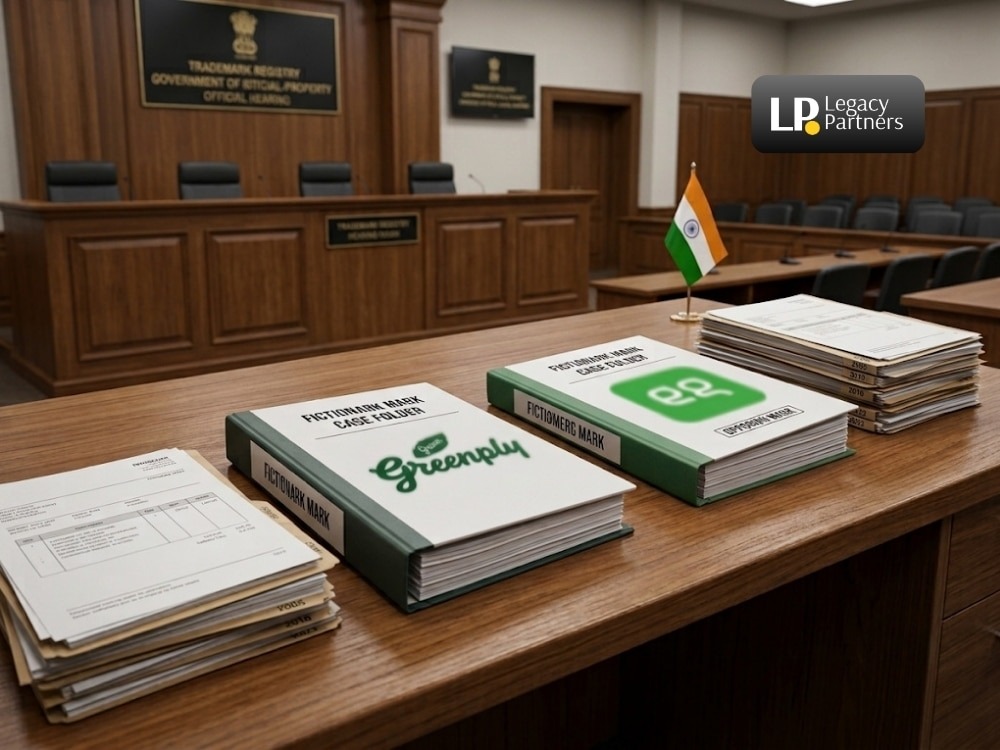

What Happened in the Evergreen vs Greenply Trademark Case?
The Assistant Registrar of Trademarks, Chennai, has dismissed Opposition No. 1026680 filed by Greenply against the trademark application for EVERGREEN. With the opposition rejected, the EVERGREEN application is now cleared to proceed to registration in Class 20 (furniture, mirrors, picture frames, and related goods).
This ruling is a useful reference point for any business dealing with a trademark opposition built around a shared, commonly used word like “green.”
A mark does not become vulnerable to opposition merely because it shares a common dictionary word with an existing brand. The overall commercial impression of the mark is what matters.
| Particulars | Opponent | Applicant |
| Mark | GREEN / GREENPLY | EVERGREEN |
| Logo Style | Green cursive script with a leaf device | Green rounded-square icon with stylised “eg” lettering |
| Claim | Deceptive similarity likely to confuse consumers | Distinctive, independently used mark since 2006 |
| Outcome | Opposition dismissed | Application allowed to proceed to registration |
Why Did Greenply Oppose the EVERGREEN Trademark?
Greenply’s opposition rested on the argument that EVERGREEN was deceptively similar to its own GREEN and GREENPLY marks. The opponent contended that:
- Consumers could associate EVERGREEN with the well-known GREENPLY brand.
- The shared word “green” created a risk of confusion in the market.
- Registration of EVERGREEN would dilute or damage its existing goodwill.
This is a common opposition strategy where a brand tries to prevent competitors from using any mark containing a word central to its own identity.
What Did the Registrar of Trademarks Decide?
After reviewing the evidence and submissions from both sides, the Registry ruled in favour of the applicant on every key point:
- The marks must be assessed as a whole, not broken into separate words or syllables.
- EVERGREEN is a distinctive composite mark that differs visually, structurally, and conceptually from GREEN/GREENPLY.
- The applicant had demonstrated genuine, long standing commercial use of EVERGREEN since 2006, backed by invoices and promotional material.
- There was no likelihood of confusion among consumers.
- There was no evidence that the applicant adopted the mark dishonestly.
- The opposition under Section 11 of the Trade Marks Act was not substantiated.
Each party was directed to bear its own legal costs, and the EVERGREEN application was permitted to move ahead to registration in Class 20.
How Did the Registry Compare the Two Marks?
Indian trademark law follows a wellestablished principle: marks are compared as a whole (antidissection rule), not by isolating shared letters or words. In this case:
- Visual comparison: GREENPLY uses green cursive script with a leaf motif. EVERGREEN’s mark uses a solid green rounded square icon with modern lettering. The overall look and feel are entirely different.
- Structural comparison: GREENPLY is a compound of “green” and “ply” (referring to plywood), while EVERGREEN is a single, independent dictionary word with its own distinct meaning.
- Conceptual comparison: “Evergreen” conveys permanence and lasting quality; “Greenply” is descriptive of a plywood product line. The ideas each mark communicates to a consumer are not the same.
A person of average intelligence and imperfect recollection, the legal standard used in India, is unlikely to mistake one mark for the other.
Why Was Prior Use Since 2006 Important to the Outcome?
Continuous, documented use of a trademark strengthens an applicant’s position significantly in opposition proceedings. In this case, the applicant supported its claim of use since 2006 with:
- Sales invoices
- Promotional and marketing material
- Other supporting commercial records
This evidence helped establish that EVERGREEN was adopted honestly and used consistently over nearly two decades, undermining any suggestion that the mark was chosen to piggyback on Greenply’s reputation.
Practical lesson: Businesses should retain dated invoices, packaging, advertisements, and marketing collateral from the very first use of a brand name. This documentation becomes critical evidence if an opposition or infringement dispute arises years later.

What Is Section 11 of the Trade Marks Act, and Why Did It Fail Here?
Section 11 of the Trade Marks Act, 1999 allows an existing trademark owner to oppose a new application on the ground that it is identical or similar to an earlier mark, and that this similarity is likely to cause confusion or deceive the public.
For a Section 11 objection to succeed, the opponent generally needs to show:
- Similarity between the marks (visual, phonetic, or conceptual)
- Similarity or overlap in the goods or services
- A resulting likelihood of confusion among the relevant public
In this case, the Registry found that the marks were sufficiently distinct in appearance, structure, and concept, so the confusion threshold under Section 11 was not met.
What Does “Likelihood of Confusion” Mean in Trademark Law?
Likelihood of confusion” is the central test in most trademark opposition and infringement cases. It asks whether an ordinary consumer, exercising normal care, would mistake one brand for another or assume they are commercially connected.
Factors typically considered include:
- Overall visual and phonetic similarity of the marks
- The nature of the goods or services and their trade channels
- The class of consumers and their level of attention
- Evidence of actual confusion, if any
- How long each mark has been in use
Here, the Registry found no evidence of actual confusion and concluded that the two marks were unlikely to be confused by consumers in the marketplace.
What Can Businesses Learn From This Ruling?
Key takeaways for brand owners and applicants:
- A common word (like “green”) used across multiple brands does not automatically make later marks confusingly similar.
- Composite marks with distinct logos, colours, and lettering styles are evaluated on their complete commercial impression.
- Longterm, welldocumented use of a mark is one of the strongest defences in an opposition proceeding.
- Filing a well supported counter statement backed by evidence significantly improves the odds of a favourable outcome.
- Even large, established brands can lose an opposition if their similarity claim does not hold up to scrutiny.
Common mistakes to avoid:
- Failing to preserve proof of first use (invoices, ads, packaging)
- Assuming a shared word automatically blocks registration
- Not responding to an opposition within the prescribed timeline
- Relying only on arguments without supporting documentary evidence
How Long Does a Trademark Opposition Take in India?
Trademark opposition proceedings in India typically take anywhere from 2 to 5 years, depending on the complexity of the case, the volume of evidence filed, and the workload of the Registry. The process generally involves:
- Filing of the Notice of Opposition
- Counter statement by the applicant
- Evidence in support of opposition
- Evidence in support of application
- Evidence in reply (if any)
- Hearing before the Registrar
- Final order
How Much Does It Cost to Defend a Trademark Opposition?
Costs vary based on the complexity of the matter, the number of hearings, and the volume of evidence involved. Typical expenses include:
- Government/statutory fees for filing the counter statement and evidence
- Professional fees for the trademark attorney or agent
- Costs of collating and notarising documentary evidence
- Hearing and appearance charges, if applicable
Businesses are encouraged to consult an authorised trademark professional early to get an accurate cost estimate based on their specific case.
Facing a Trademark Opposition in India?
Speak with our trademark team for strategic guidance on counter statements, evidence of prior use, and opposition defence, backed by more than 15 years of experience as an authorised representative before the Trademark Registry. info@legacypartners.global