 Global Trademark

Trademark Registration in the United States (US): Secure Your Brand Rights
A federal trademark registration from the United States Patent and Trademark Office (USPTO) gives you nationwide rights, a presumption of ownership, access to federal courts, and recordal with US Customs and Border Protection. Registration is optional, but common-law rights from use alone are narrower and harder to prove. Our trademark consultants handle search, filing and follow-up for businesses trading into the United States.
On this page
United States trademark registration at a glance
- crumb
- United States (US)
- facts
- Trademark registration in the USA at a glance
- why
- Why register your trademark in the USA
- services
- Our trademark services in the USA
- process
- How to register a trademark in the USA
- steps_lead
- -
- documents
- Documents required for trademark registration in the USA
- poa
- Power of attorney requirements for foreign applicants in the USA
- fees
- Trademark registration and renewal fees in the USA
- timeline
- Timeline, validity and renewal
- tips
- What to know before filing in the USA
- stories
- Client stories
- faq
- Trademark registration in the USA: FAQ
- insights
- Insights on US IP protection
- cta_title
- Register your trademark in the USA today
- cta_text
- Speak to our trademark consultants in the United States. Send your mark and we will reply with a free search and a fixed written quote within one working day.
* Timelines assume no objections or oppositions. Laws change, so contact us to confirm current requirements.
Check if your mark is available in the USA
Trademark search from US$49
Before you file with the USPTO, our attorneys search the US federal register for identical and similar marks and tell you whether your mark is likely to be registrable. A clear search reduces the risk of refusal and wasted filing fees.
Why register your trademark in United States
Nationwide priority
A federal registration gives you rights across the country and a clear basis to act against later filers who copy your mark.
A large consumer market
The US is one of the largest consumer markets in the world, and brands from every sector trade into it through online and retail channels.
Counterfeits are common
Copied goods are frequently sold online and at the border. A registration is the basis for customs recordal with US Customs and Border Protection and for complaints against counterfeit sellers.
Required by retailers and marketplaces
Major retailers, distributors and online platforms often ask for proof of registration before listing or signing agreements.
Our trademark services in United States
End-to-end support from our licensed in-country attorneys, from the first search to lifelong protection.
Trademark search
class selection, identification of goods and services, filing and follow-up to certificate.
Trademark registration
class selection, identification of goods and services, filing and follow-up to certificate.
Office action response
replies to objections raised by the USPTO.
Opposition and cancellation
filing or defending oppositions and cancellation actions.
Renewal and recordals
Section 8 and 9 filings, assignments, licences and changes of name or address.
Trademark watch
monitoring of published marks for conflicts.
Trademark registration process in United States
Here is how to register a trademark in United States, step by step.
Here is the step-by-step process followed for trademark registration in the U.S.
Search and classify (1–2 weeks)
We search the USPTO register for identical and similar marks and map your goods and services to the correct Nice class.
Choose a filing basis (same week)
Use-based (Section 1(a)) if the mark is already in commerce, or intent-to-use (Section 1(b)) if not.
File with the USPTO (same day)
We file online with the mark image, identification of goods and services, and the base fee per class.
Examination (4 to 5 months)
A USPTO examining attorney checks formalities, distinctiveness and conflicts with earlier marks.
Publication and opposition (30 days)
Accepted marks are published for opposition, extendable up to 180 days.
Notice of Allowance or registration
Intent-to-use applicants receive a Notice of Allowance and must file a statement of use later.
Registration and certificate (10 to 11 months from filing)
With no opposition, the mark is registered and the certificate issued. Protection runs for 10 years from registration.
Ready to file in United States?
File your trademarkStart your application in a few minutes. Nothing is filed until you approve the written quote.
Documents required for trademark registration in United States
Clear image of the mark in JPG or PNG format (for logos, specify colour claim if relevant)
Applicant name, address, legal entity and domicile
List of goods or services by class
Filing basis and dates of first use (for use-based applications)
Specimens showing the mark in use (for use-based applications)
Signed declaration by the applicant or authorised signatory
Attorney appointment, if using an agent
Power of attorney requirements for foreign applicants in United States
All foreign-domiciled applicants, registrants and other parties must be formally represented by an attorney who is active and licensed to practise law in the United States, and that attorney files the power of attorney through the USPTO. Confirm whether the signed declaration must be verified under penalty of perjury and whether notarisation is required.
Trademark registration and renewal fees in the USA
The USPTO fees below are charged per class. Verify against the current USPTO fee schedule before publishing.
| Fee | USD (per class) |
|---|---|
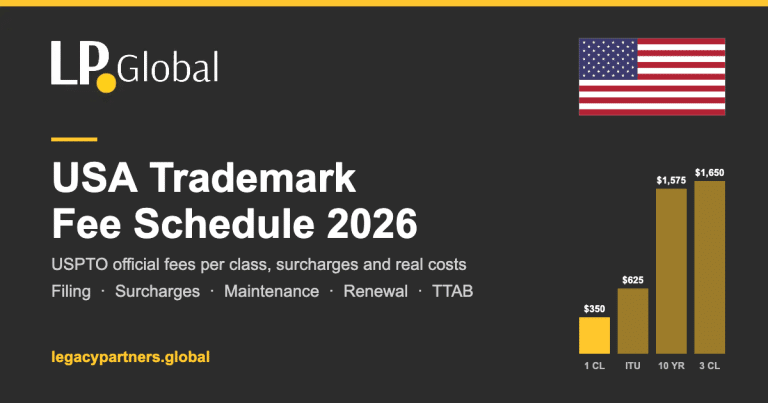
| Base application (TEAS Standard) | $350 |
| Statement of use (intent-to-use only) | $150 |
| Section 8 declaration of use (years 5–6) | $325 |
| Section 15 declaration of incontestability (optional) | $250 |
| Section 8 + Section 9 renewal (every 10 years) | $650 |
| Grace period surcharge (per filing) | $100 |
All fees are official USPTO government fees (effective January 2025). A $200 surcharge applies if custom, free-form descriptions are used instead of pre-approved ID manual terms. Legal fees are separate. Contact us for a fixed written quote.
Timeline, validity and renewal
A straightforward application takes about 4 to 5 months to first examination and 10 to 11 months to final registration, if it is filed cleanly and meets no office actions, refusals or third-party oppositions. Intent-to-use applicants have 6 months after the Notice of Allowance to file a statement of use or request a 6-month extension. Up to five extensions are allowed, for a maximum of 36 months to begin commercial use (per screenshots). Registration lasts 10 years from the registration date. A Section 8 declaration of use is due between years 5 and 6, and the Section 9 renewal is filed every 10 years, usually together with a Section 8 declaration confirm windows and grace periods.
Trademark law and IP office in the USA
Federal trademarks are governed by the Lanham Act, 15 U.S.C. § 1051 et seq. The USPTO examines and registers marks. The United States has been a member of the Madrid Protocol since November 2, 2003, so an international registration filed through WIPO can designate the US and extend protection here, alongside the option of a direct national filing. Disputes go to the Trademark Trial and Appeal Board (TTAB) or the federal courts.
For Madrid filings, WIPO's status tracking works as follows (per screenshots). "International registration" means WIPO has recorded the mark, but no national protection exists yet. "Provisional refusal" means the USPTO found a conflict or technical error and started the response timeline. "Statement of grant of protection" means the country has accepted the mark. The "central attack" period lasts the first 5 years, during which cancellation of the home-country basic mark can cancel the international registration in every designated country.
Use requirements and non-use cancellation
Use-based applications require use in commerce at filing. Intent-to-use applications must be followed by use before registration. A registration can be cancelled if the mark has not been used for three consecutive years, which creates a presumption of abandonment confirm. Keep dated invoices, sales records and packaging that show the mark in commercial use in the United States.
Opposition, objections and appeals
Office actions
Respond within 3 months, extendable once by 3 months for a fee of about $125 per class, for a maximum of 6 months (per screenshots). Applicants under a Madrid Section 66(a) filing have 6 months, which cannot be extended. Missing the deadline means the application is deemed abandoned. A petition to revive can be filed within 2 months of the abandonment notice if the delay was unintentional.
Opposition
Any party who believes it would be harmed may oppose within 30 days of publication, extendable up to 180 days from publication confirm. The applicant responds, and the USPTO decides.
Appeals
Refusals can be appealed to the TTAB, and decisions can be reviewed by the federal courts within x days.
Trademark enforcement and infringement in the USA
A registered trademark gives you the legal standing to act against copycats in the United States, including in federal court.
What counts as infringement
Using an identical or similar mark for the same or similar goods or services, selling counterfeit products, or importing goods bearing your mark without consent.
Your enforcement options
- Cease-and-desist letter: often the most practical first step with sellers and importers.
- Customs recordal: record the mark with US Customs and Border Protection to stop counterfeit imports.
- Court action: claim an injunction and damages in federal court.
- Online takedowns: remove infringing listings on marketplaces and social media.
Defending your registration
Watch published marks and oppose conflicting applications within the 30-day window.
How we help
Our trademark consultants handle evidence gathering, cease-and-desist letters, oppositions and coordination with US counsel.
What to know before filing in United States
Search before you file
A conflicting earlier mark is the most common reason for objections.
Pay per class
Each class adds its own base fee, so list only goods and services you plan to sell.
Plan for use
Intent-to-use registrations need a statement of use, and non-use for three years can lead to cancellation.
Check the Madrid option
It can be cheaper to designate the US through an international filing, but a national filing gives more direct control confirm.
Client stories
Businesses that trust us with their brands across borders.
What sets Legacy Partners apart is their dedication to building strong client relationships. Their team was approachable, responsive, and always ready to guide us through the trademark registration process. We felt valued and supported from start to finish.

Bareer JazimManaging Director, Grow Learn
Working with Legacy Partners for our trademark registration was an excellent experience. Their expertise, attention to detail, and clear guidance made the process smooth and hassle free. We truly appreciate their responsive communication, personalized service, and commitment to building strong client relationships. Highly recommended for professional and reliable trademark service.

AshiqCEO Of Cyber Shelter
Legacy Partners provided excellent support throughout our trademark registration process. Their expertise, attention to detail, and professional approach gave us confidence at every stage. We truly appreciate their reliable service and commitment to protecting our brand.

AshkarCeo Of Mouzy
* Client stories are shared with permission.
Trademark registration in United States: FAQ
How long does trademark registration take in the USA?
About 10 to 11 months from filing to registration if the application is filed cleanly and there is no office action, refusal or opposition. First examination usually takes place 4 to 5 months after filing.
How much does trademark registration cost in the USA?
The USPTO base fee is $350 per class. A statement of use costs $150 per class for intent-to-use filings. Renewal costs $650 per class (Sections 8 and 9 combined, per screenshots). Contact us for a fixed written quote.
How long is a US trademark valid?
10 years from registration, renewable every 10 years with the required filings.
Can I file one application for several classes?
Yes, but each class is charged separately.
Do I need a US attorney if I am based abroad?
Yes. All foreign-domiciled applicants must be formally represented by an attorney who is active and licensed to practise law in the United States. Your attorney then handles the filing and all USPTO correspondence.
How do I choose a trademark consultant in the USA?
Check that they work with US-licensed attorneys, manage the filing and office action responses, and quote official and professional fees separately.
Is a foreign trademark valid in the USA?
No. You must register in the United States, nationally or through Madrid.
What can I do if someone copies my trademark in the USA?
Send a cease-and-desist letter, record the mark with customs, or go to federal court.
Do I need to use my trademark before filing?
Not for an intent-to-use filing, but a statement of use is required before registration. A mark unused for three consecutive years can be cancelled.
Can I register through the Madrid Protocol?
Yes. The United States has been a Madrid Protocol member since November 2, 2003, so an international registration can designate the US. A national filing with the USPTO gives you more direct control over the application confirm.
What happens if the USPTO objects to my application?
You have 3 months to respond, extendable once by 3 months for a fee.
How long is the opposition window?
30 days from publication, extendable up to 180 days.
What happens if I miss a USPTO deadline?
The application is deemed abandoned. A petition to revive is possible within 2 months of the notice if the delay was unintentional.
Insights on United States IP protection
Global Trademark Global Trademark
 United States
Trademark registration in nearby countries
Register your trademark in United States today
Speak to our trademark consultants in United States. Send your mark and we will reply with a free search and a fixed written quote within one working day.

Reviewed by Hashim Wafa, Corporate & Cross-Border IP LawyerLicensed trademark attorney
This page is general information, not legal advice. Official requirements and fees can change; we confirm the current position for your matter before filing.
