Choosing Trademark Filing Services for Overseas Expansion
How to compare trademark filing services for overseas expansion: clearance quality, attorney responsibility, filing route, excluded work and who owns the deadlines.

Choose trademark filing services that provide country-specific legal assessment, licensed attorney oversight and a written scope covering what happens after submission. Compare providers on clearance quality, filing strategy, excluded work and deadline responsibility, not just the advertised starting price. A filing receipt confirms submission. It does not confirm that your brand is clear to use or that it will be registered.
For overseas expansion, the right provider turns your launch plans into a practical protection strategy: identifying the countries, marks and goods or services that matter first, then explaining the risks before you commit to filing. A provider that submits applications without discussing those decisions is leaving the important work with you.
Country knowledge should be visible from the first conversation. If you are launching in Shanghai, ask how the provider will assess Chinese-language branding and earlier local rights. Our China trademark registration guide gives the country context, but choosing a provider needs a separate assessment of its legal responsibility, scope and communication.
What should trademark filing services include?
A useful engagement separates assessment, application preparation and post-filing work. These are different tasks, and paying for one does not include the others. Ask for a written description of each deliverable before you authorise the application.
Before filing, the provider should identify the proposed owner, review the mark, discuss the relevant markets and prepare an appropriate goods and services specification. It should also say whether the search is a basic screening exercise or a legal assessment of registration and use risks.
The filing scope should then make four things clear:
- Applications covered. The countries, filing routes, marks and classes included in the instructions.
- Attorney responsibility. Who reviews the application and who acts before each trademark office.
- Post-filing work. Whether examination reports, objections, publication and registration formalities are included.
- Ongoing management. Who tracks deadlines, forwards official correspondence and handles renewals or monitoring.
Ask what you receive as evidence of filing, including the application number, filing date, owner details and submitted specification. Check those documents promptly rather than assuming the submission matches your instructions.
Service boundaries matter most when something goes wrong. A provider should be able to explain how it handles an objection or an opposition without first renegotiating who is responsible for receiving the notice.
How can you tell whether a search is meaningful?
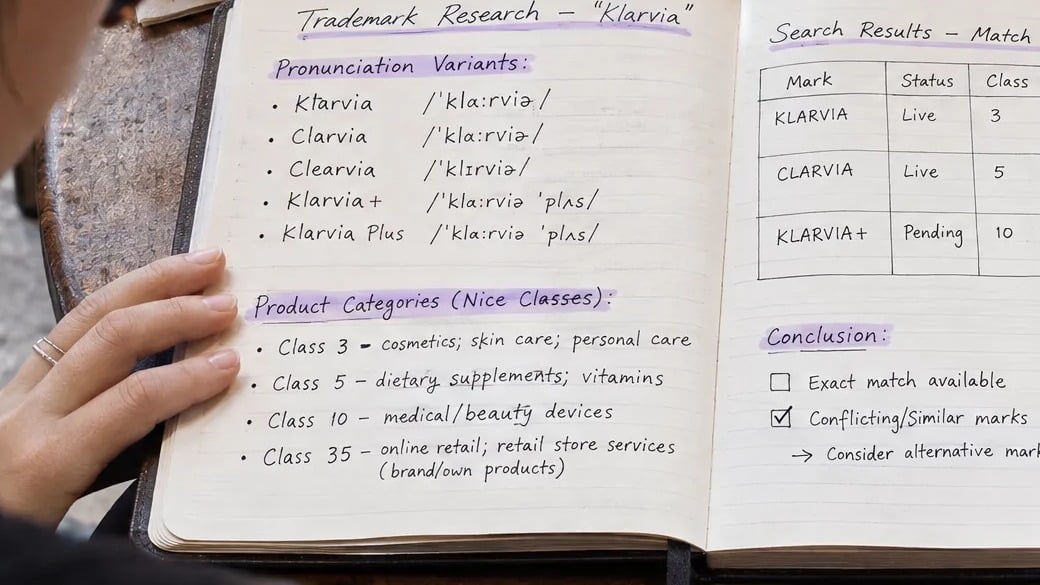
Reliable providers distinguish an identical-name lookup from a clearance assessment. A database search can identify obvious conflicts, but an empty results page does not establish that a mark is available.
A preliminary search may miss similar spellings, phonetic equivalents, translations, transliterations or visually similar logos. Depending on the country, relevant rights may also arise from use rather than registration. Registry data has limitations of its own, including publication delays and incomplete information about a mark’s current legal position.
A legal clearance assessment goes further by interpreting the results. It considers the similarity of the signs, the relationship between the goods or services and the applicable rules. It should also assess whether the proposed mark is inherently registrable, rather than looking only for earlier registrations.
Ask the provider to describe the databases, countries, languages and classes covered, and to explain the material findings with practical options: narrowing the goods, changing the branding, or taking further local advice.
The most useful deliverable is a reasoned risk assessment, not a promise of availability. No search can guarantee that an examiner will accept the application or that another business will not object.
Is your mark strong enough to justify filing?
Before comparing submission packages, assess what you are trying to protect. A distinctive name has a stronger starting position than wording that simply describes the product, its quality or its geographic origin.
An ordinary product name cannot usually function as an exclusive trademark for that product. Descriptive wording may also face objections, although the rules and any acquired-distinctiveness route vary by jurisdiction. A stylised logo does not necessarily give you broad rights over weak wording inside it.
Good providers raise these issues before preparing applications. Ask whether protection should cover the word mark, the logo, a local-language version, or separate applications for more than one version.
The goods and services specification deserves equal attention. The Nice Classification organises goods and services into classes, but a class number alone does not define the protection. The wording has to fit your business and the receiving office’s requirements. Our guide to common trademark registration mistakes explains why weak marks and unsuitable classifications undermine an otherwise orderly filing.
Who takes legal responsibility for each application?
A single commercial contact is convenient, but it should not obscure who does the legal work. Ask for the identity and jurisdiction of the attorney responsible for reviewing your application and, where applicable, the local representative appearing before the trademark office.
Verify attorney credentials through the relevant official professional register or licensing authority. A provider’s company registration is not evidence that its staff may represent applicants before a particular office.
Representation requirements vary. The USPTO, for example, requires foreign-domiciled applicants to be represented by a US-licensed attorney. Do not assume an overseas coordinator can personally act before every office.
Establish who checks instructions, approves translations and receives official notices, and how the lead contact and local attorney divide responsibility when a legal question needs direct local advice. The engagement should identify the applicant correctly and explain how records transfer if you change providers. You should keep access to application numbers, correspondence and filing documents, because continuity matters if your contact leaves or a local associate changes.
Which filing route fits your expansion plan?
A provider should recommend a route based on your countries, eligibility and risk tolerance, not on which submission process is easiest. National applications, regional systems and the Madrid System serve different needs.
National filing is generally the safer route where independence from a home application matters. Each application stands separately from the base mark, and local counsel can tailor the filing to national practice. That does not remove local examination risks or earlier third-party rights.
The WIPO Madrid System can simplify filing and administration across participating jurisdictions, but it does not create a single worldwide trademark. Each designated office examines protection under its own law and can refuse it.
For the first five years from the international registration date, the international registration depends on the base application or registration. If the base loses effect in that period, the international registration can be cancelled to the same extent, and proceedings started within those five years can have consequences if they are decided later. That dependency is the central attack risk, and it is the reason we usually recommend national filing. Our international trademark filing guide sets out the process, and the myth of international registration through WIPO explains the trade-off in full.
How should you compare quotes and timelines?
Compare providers on the same assumptions: one identified owner, the same mark versions, the same countries and equivalent goods and services. Otherwise a lower quote may simply exclude work that another provider includes.
| Item | What to confirm in writing | Why it affects the comparison |
|---|---|---|
| Official office fees | The named office, the applicable year and the current fee schedule | Fees and charging structures differ by jurisdiction |
| Search and assessment | Registers, languages, classes and legal analysis covered | A basic lookup is not equivalent to clearance advice |
| Application preparation | Specification drafting, translations and document checks | These may be excluded from a submission-only service |
| Examination responses | Which objections are included and when a separate quote applies | The initial filing may not cover substantive argument |
| Publication and registration | Any later official payments or completion formalities | Submission may not be the final chargeable stage |
| Timing | Provider preparation time against office processing time | The provider controls only part of the process |
For a filing planned in 2026, ask for the office’s 2026 fee schedule or confirmation of the schedule in force. If an official amount cannot be verified, confirm it with the office rather than relying on an estimate presented as fixed. A transparent provider separates official charges from its own work and identifies the exclusions. For timing, ask for a dated, country-specific range with separate assumptions for objections and oppositions, and do not treat a filing date as a registration deadline.
What happens after filing or a refusal?
Submission begins an examination process. It does not finish the legal work. An office may question the classification, request documents, object to descriptiveness or raise earlier rights, and third parties may oppose the application at the applicable stage.
Before appointing a provider, ask how notices are received, assessed and escalated. A useful update identifies the issue, the response deadline, the available options and any work needing separate authorisation. Forwarding an official letter without explanation leaves a business owner unable to decide.
Ask how deadlines are docketed and how the provider confirms that local instructions have been received, and agree a process for urgent matters when your usual contact is away.
After registration, clarify who records renewal dates and alerts you to use requirements. Monitoring for later applications is a separate service from renewing your own registration, and neither automatically includes enforcement. If another business adopts a similar brand, investigation, opposition, negotiation and infringement proceedings may each need different instructions and local advice.
How can you test a provider before committing?
Send each shortlisted provider the same short brief: proposed owner, mark, products or services, target countries and expected launch dates, plus any earlier applications, known disputes and planned local-language branding. Identical briefs make the responses comparable.
Look for useful questions coming back. A provider should notice an unclear ownership structure, a specification that does not match the products, or an expansion plan that assumes one filing protects every country.
Warning signs are guaranteed registration, unnamed legal representatives, unclear ownership of records, and pressure to file before discussing search results. Before signing, ask for a sample reporting format with confidential details removed. It should be obvious how you will see the application’s status, the next action and the responsible person without reconstructing the history from scattered emails.
Frequently asked questions
Can I file directly instead of using a service? Sometimes, depending on the office’s representation rules and your domicile. Direct filing leaves you responsible for the application, classification and deadlines. Check the national office’s requirements first.
Does one application protect my brand worldwide? No. Protection is territorial. The Madrid System coordinates applications across designated participating jurisdictions, but each designation is still subject to local requirements.
Are low-cost filing services unsuitable? Not necessarily. A limited service may suit a straightforward task if its limits are understood. Compare equivalent work and confirm who handles legal assessment, objections and later deadlines.
Can a provider guarantee registration? No. No provider controls the office’s decision or third-party objections. A responsible assessment explains the risks and options without promising an outcome.
Should monitoring be included automatically? Do not assume it is. Ask which registers and marks are monitored, how conflicts are assessed and whether response work needs a separate engagement.
Last checked: November 2026. Reviewed by Hashim Wafa, Trademark Attorney. This article is general information, not advice on a specific filing.
How LP Global supports your next filing
LP Global coordinates international trademark work across 190+ countries through licensed local attorneys, with 15+ years of experience and 90+ qualified IP attorneys in the network. We quote official fees and professional fees separately, in writing, with the scope defined before any work starts.
Start with the $49 trademark search for one word mark or logo, up to 3 classes and one register. A qualified trademark lawyer reviews every result and signs the report, which you receive within 24 working hours.