
Why a Trademark Name Search Must Check Sound-Alike Marks
A trademark name search must check sound-alike marks, not just identical spellings. How to test phonetic variants, compare related goods and log the results.

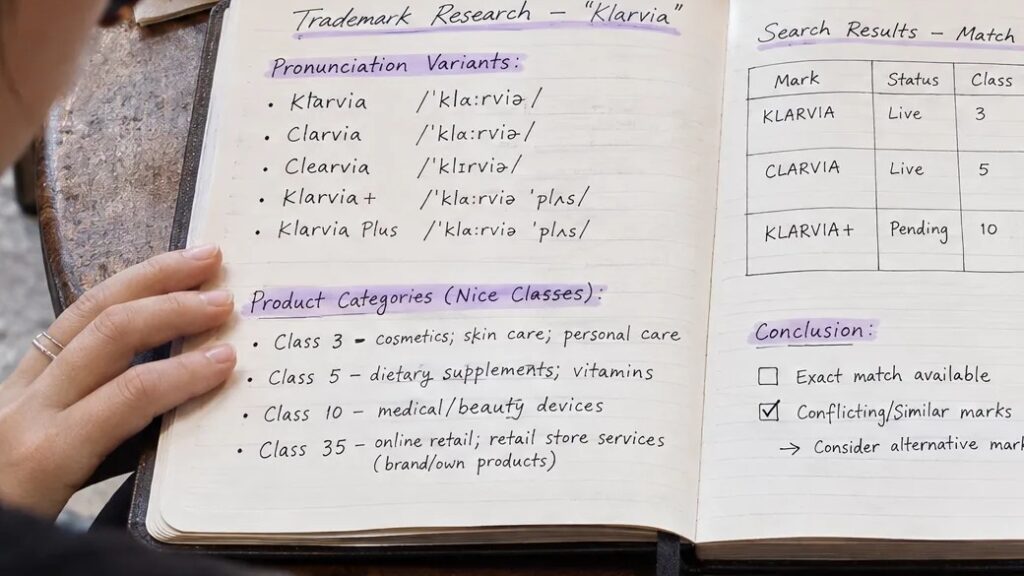
A trademark name search must check names that sound alike, not only identical spellings, because customers often hear a brand before they see it. Similarity in sound can support a likelihood-of-confusion refusal where the goods or services are sufficiently related. A different spelling, or an available domain, does not establish that a name is safe to use or register.
Why can differently spelled names still conflict?
Trademark examination is not a spelling test. The USPTO’s likelihood-of-confusion guidance explains that marks can be similar in sound, appearance, meaning or overall commercial impression. They do not need to be identical to create a conflict.
Consider the hypothetical names “Cora” and “Kora” for closely related products. A customer hearing either name in a recommendation might not know which spelling to search for. Changing the first letter would not necessarily resolve that problem.
Pronunciation also depends on language and local usage. For a launch in Shanghai, our China trademark registration guide gives the country-specific context, but clearance should separately assess the relevant Chinese-language names alongside the Latin-script brand.
The practical question is whether customers could believe the two businesses are connected, not whether their names contain different letters.
How should a trademark name search test pronunciation?
Start by saying the proposed name aloud without showing anyone the spelling. Record its likely pronunciations, then write down the alternative ways someone might spell what they heard. Include reasonable variations rather than every imaginable combination of letters.
The pairs below illustrate search patterns only. They have not been cleared for use.
| Search pattern | Illustrative variations | What to investigate |
|---|---|---|
| Alternative consonants | Cora / Kora | Different letters representing the same sound |
| Phonetic spelling | Fonic / Phonik | Simplified or stylised spellings |
| Equivalent letter combinations | Nexa / Neksa | Different combinations with similar pronunciation |
| Spacing changes | BrightNest / Bright Nest | Joined and separated versions of the same spoken name |
| Local-language rendering | Latin-script name / local transliteration | Names customers may pronounce similarly in the target market |
Search the whole name first, then investigate its distinctive components. A descriptive addition such as “jewellery” or “foods” may do little to distinguish otherwise similar brands, depending on the overall impression.
Use whatever phonetic or fuzzy-search tools the database provides, but do not rely on them alone. Automated matching can miss an unusual pronunciation, a transliteration or a brand containing an unexpected letter combination. Check the database’s current help instructions before using wildcard or advanced-search syntax.
Where should you search beyond exact registry matches?
A trademark name search needs a defined territory and more than one source. For a US launch, federal records, state records and evidence of unregistered use each answer a different question.
What does the USPTO database cover?
Use the current USPTO Trademark Search system to investigate federal applications and registrations. Instructions written for the retired TESS system may no longer match the current interface.
Begin with the exact name, then search the pronunciation variants you identified. Review the actual records, including their goods or services, status and ownership. A results-page summary is not enough to assess a close match.
Do not restrict the first pass so tightly that neighbouring products disappear. Narrow searches help manage results, but they can also hide conflicts.
What requires separate checking?
State trademark registrations are separate from the federal register, so the relevant state databases may need their own searches.
Unregistered use requires a different investigation again. Search engines, marketplaces, business directories, industry publications and social platforms can reveal businesses using similar names without any federal registration. US common law rights can arise through use, although their scope depends on the facts.
A company-name record, domain registration or social handle is a useful lead, not proof of clearance. Our guide to common trademark registration mistakes explains why skipping clearance undermines an otherwise well-prepared filing.
Why do goods and services matter as much as pronunciation?
A trademark name search becomes useful only when the results are connected to what the business actually sells. Two similar-sounding marks do not automatically conflict, but different product descriptions do not automatically make them compatible either.
Examiners consider whether the goods or services are related in a way that could lead customers to assume a common commercial source. They need not be identical or directly competitive.
Take a jewellery brand selling engagement rings and wedding bands. A useful search brief identifies the jewellery products and any retail services relevant to the protection sought, rather than a single ring description. Nice Classification organises goods and services for filing: jewellery generally falls in Class 14, while relevant retail services fall in Class 35.
Class numbers are not legal barriers separating all possible conflicts, though. Related goods or services can sit in different classes. Describe your current offering precisely and identify credible near-term expansion. An applicant selling coffee beans should not dismiss a similar cafe name solely because the records carry different class numbers.
What should you put in a search log?
Document each search so a reviewer can understand what was checked and reproduce the work. “Nothing identical appeared” leaves too many questions unanswered.
| Field | What to record |
|---|---|
| Proposed mark | Exact spelling, likely pronunciations and relevant local-language versions |
| Commercial scope | Products, services, customers and intended markets |
| Search details | Database or source, date, query and filters used |
| Close matches | Mark, owner, application or registration number and status shown |
| Goods and services | Relevant wording from each potentially conflicting record |
| Follow-up | Saved evidence, unresolved questions and recommended next action |
Preserve links or copies of significant records, and distinguish verified information from assumptions. If a marketplace listing suggests ongoing use, record what it shows and the date you accessed it. Do not treat the listing date as proof of first use.
For a close phonetic match, explain why you flagged it: similar pronunciation, overlapping products or a shared distinctive element. That is more useful than an unexplained “high risk” label.
How should you assess similar and inactive marks?
Finding a similar name is a reason to investigate, not an instruction to abandon your brand. Equally, a record marked “dead”, “cancelled” or “expired” is not an automatic green light.
What makes a close match more concerning?
Review the marks as a whole, including sound, appearance, meaning and commercial impression. Then examine the relationship between the goods or services, and any other factor relevant under the jurisdiction’s law.
A shared distinctive word usually deserves more attention than a shared descriptive term, but assumptions about which element dominates should be tested against the complete marks. Adding a logo, changing capitalisation or inserting a hyphen may not address a phonetic conflict at all.
For US records, distinguish a pending application from a registration and inspect the prosecution history where necessary. Filing dates and claimed use dates matter, but they do not resolve every priority question by themselves.
Why do inactive records still deserve attention?
An inactive federal record may no longer present the same registration obstacle, yet the owner could still be trading under the name. Other registrations or unregistered rights may also exist.
Check the reason for the status and look for current commercial use. Do not assume an abandoned application proves the name itself was abandoned. Whether enforceable rights remain, and where, is a question for a lawyer.
What changes when the brand enters another country?
A trademark name search is territorial. A clear US result does not establish availability in China, the UAE or any other export market, and the legal significance of earlier use differs between jurisdictions.
The WIPO Global Brand Database is a useful starting point for international searching, but its coverage is not a substitute for checking the relevant national or regional office’s records.
For China, consult CNIPA records and assess the appropriate Chinese-language equivalents. A local-language name can resemble another brand in pronunciation even when the Latin-script versions look unrelated. Translation, transliteration and local pronunciation each need separate attention.
Prioritise the countries where you manufacture, sell, franchise or plan a credible launch. Search scope should follow the business plan rather than the location of the head office. Our explanation of why trademark protection matters in a global business landscape puts that territorial planning in context.
When should an attorney review the results?
Professional review earns its place when a search reveals close phonetic matches, crowded naming patterns, uncertain ownership or records covering related goods. It is also sensible before committing real money to packaging, signage, franchise materials or a multi-country launch.
Ask what the proposed search covers. A register screening for one country is a different exercise from broader clearance that investigates unregistered use, local-language variants and several markets. Neither the word “global” nor the number of results tells you the scope.
A useful review explains the significant matches, the limitations and the next steps, which might include deeper investigation, revising the name, narrowing the specification or proceeding with a clearly understood risk.
No search guarantees registration or freedom from challenge. New applications appear, records have limitations, and the legal assessment can depend on evidence no database holds.
Last checked: November 2026. Reviewed by Hashim Wafa, Trademark Attorney. This article is general information, not legal advice on a specific name.
Frequently asked questions
Does a different spelling avoid a trademark conflict? Not necessarily. Similar pronunciation can contribute to confusion, particularly where the goods or services are related. The complete marks and the applicable local law both matter.
Does an available domain mean my brand name is available? No. Domain availability establishes no trademark rights and does not show that similar-sounding brands are absent from the market.
Is a clear trademark name search enough to guarantee registration? No. A search helps assess earlier-rights risk, but an office may raise other objections, including descriptiveness or lack of distinctiveness, and third parties may oppose.
Can I ignore a similar mark in a different class? No. Classes organise applications, but related goods or services can fall in different classes. Review the actual wording and the commercial relationship first.
Want an attorney to review your proposed name?
LP Global runs trademark clearance and international protection in 190+ countries through licensed local attorneys, with 15+ years of experience and 90+ qualified IP attorneys in the network. A qualified trademark lawyer reviews every result and signs the report.
Order the $49 trademark search for one word mark or logo, up to 3 classes and 1 country or regional register. You receive a signed PDF report with a risk rating within 24 working hours.